COMPANY
Shopify
ROLE
Product Designer
Team
PM · Engineers · Content · Data
· SEO
Timeline
5 Months

TL;DR
Consolidated three fragmented directories used to connect merchants with agencies, developers, designers, and marketers into a single self-serve marketplace. The redesign improved discovery and evaluation while reducing operational overhead and eliminating 325,000+ lines of legacy code.
THE CHALLENGE
How might we consolidate three partner directories into one experience while helping merchants confidently evaluate and connect with the right service provider?
Shopify merchants often rely on agencies, developers, designers, and marketers ("Shopify Partners") to grow their businesses. However, Partner discovery was fragmented across three separate directories, making it difficult to evaluate expertise, credibility, and fit. At the same time, maintaining multiple marketplace experiences created growing operational overhead for Shopify.
01 — UNDERSTANDING THE PROBLEM
We translated merchant hiring behaviors into a unified discovery experience.
To understand how merchants discovered and selected Partners, I conducted merchant interviews, usability testing, and concept evaluations. I also reviewed marketplace data, Partner feedback, and existing research to understand how merchants evaluated expertise, credibility, and fit.
Through this research, we found that successful Partner selection followed a repeatable evaluation process. Merchants needed evidence of expertise, proof of past success, and confidence that a provider was the right fit for their business.
Our challenge wasn't helping merchants find providers—it was helping them confidently choose one.
02 — KEY DESIGN DECISIONS
Design Explorations
Based on these insights, we explored several approaches for simplifying discovery, improving trust, and reducing marketplace complexity.
Homepage Iteration
Explorations
Early design

B. Iteration

What changed
Added prominent search directly within the hero
Shifted from category-first browsing to search-assisted discovery
Simplified service taxonomy
Optimized for a larger provider ecosystem after consolidation
Why
Consolidating three directories significantly increased the number of available providers. To reduce browsing friction, we shifted discovery toward search-first experiences that helped merchants quickly identify relevant expertise.
Search & Filtering Iteration
Explorations
Early design

B. Iteration
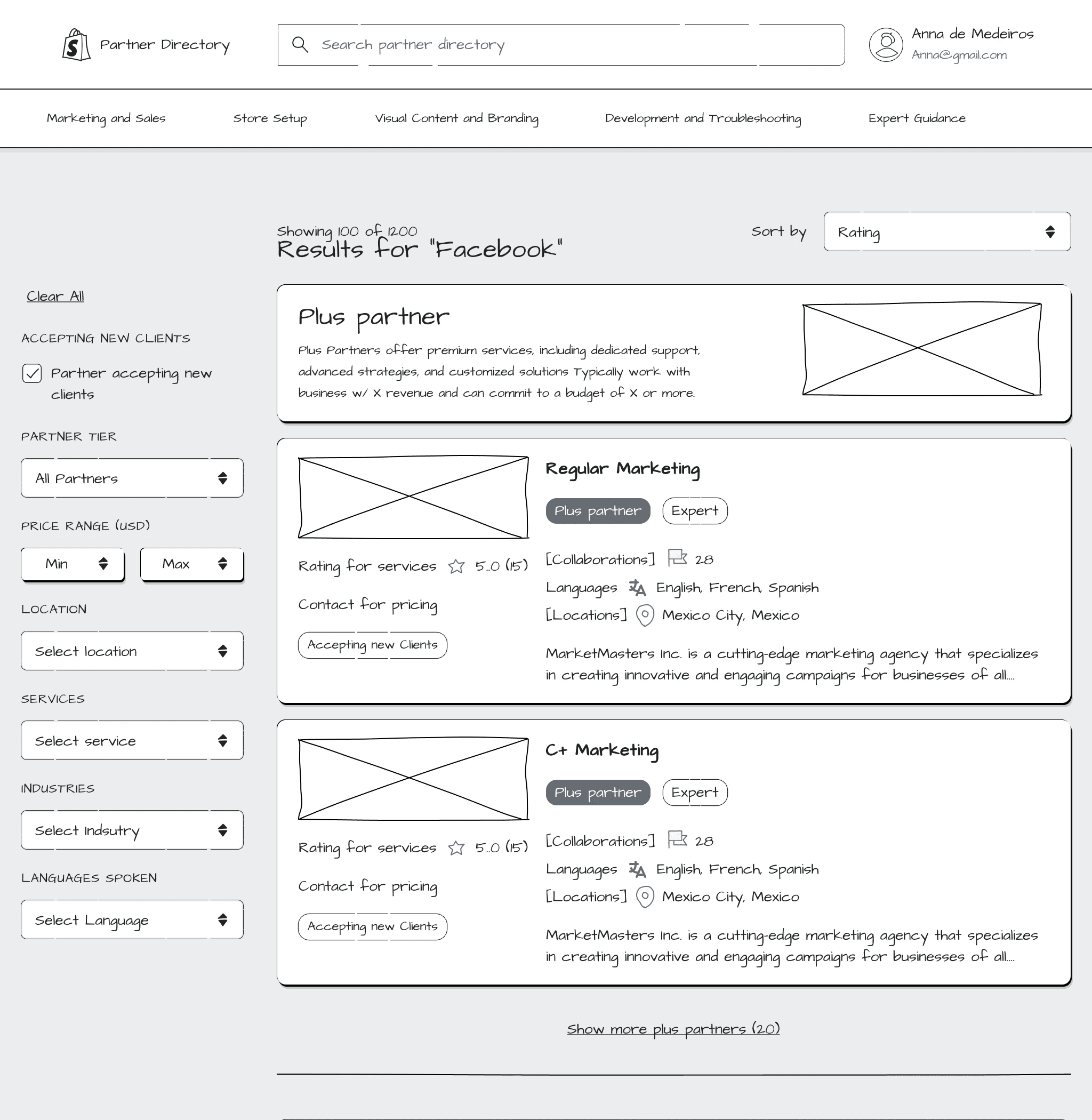
What changed
Simplified filtering architecture
Added more targeted filtering options
Improved result cards with richer comparison information
Prioritized relevance over browsing
Why
As more providers entered the unified marketplace, filtering became increasingly important. Research showed merchants wanted to narrow options based on expertise, services, certifications, and business needs. A richer filtering system helped merchants efficiently evaluate a larger pool of potential providers.
Partner Profile Iteration
Explorations
Early design

B. Iteration

What changed
Removed testimonial content
Removed project thumbnails
Simplified profile hierarchy
Increased emphasis on credentials, services, ratings, and expertise
Why
Early concepts included richer content modules, testimonials, and visual project showcases. While these elements provided additional context, they introduced significant governance, moderation, and maintenance requirements.
The final design prioritized scalable trust signals that could be consistently maintained across thousands of provider profiles. Richer content experiences were intentionally deferred until we could establish scalable governance, moderation, and quality standards across thousands of provider profiles.
03 — FINAL SOLUTION
Unifying Discovery, Evaluation, and Connection


Rationale
The final solution consolidated three separate Partner directories into a single marketplace where merchants could discover, evaluate, compare, and connect with providers from one destination. The experience combined search, filtering, standardized profiles, and direct contact flows to support confident hiring decisions.
1
Intent-Based Search

Search was redesigned to help merchants find either specific providers or service categories. Rather than relying solely on keyword matching, the experience interpreted whether merchants were searching for a Partner or a service and surfaced more relevant results.
2
Enhanced Search & Filtering

As the unified marketplace grew, merchants needed efficient ways to narrow options. We introduced filtering for services, expertise, certifications, location, and availability, helping merchants quickly identify providers that matched their needs.
Standardized Partner Profiles
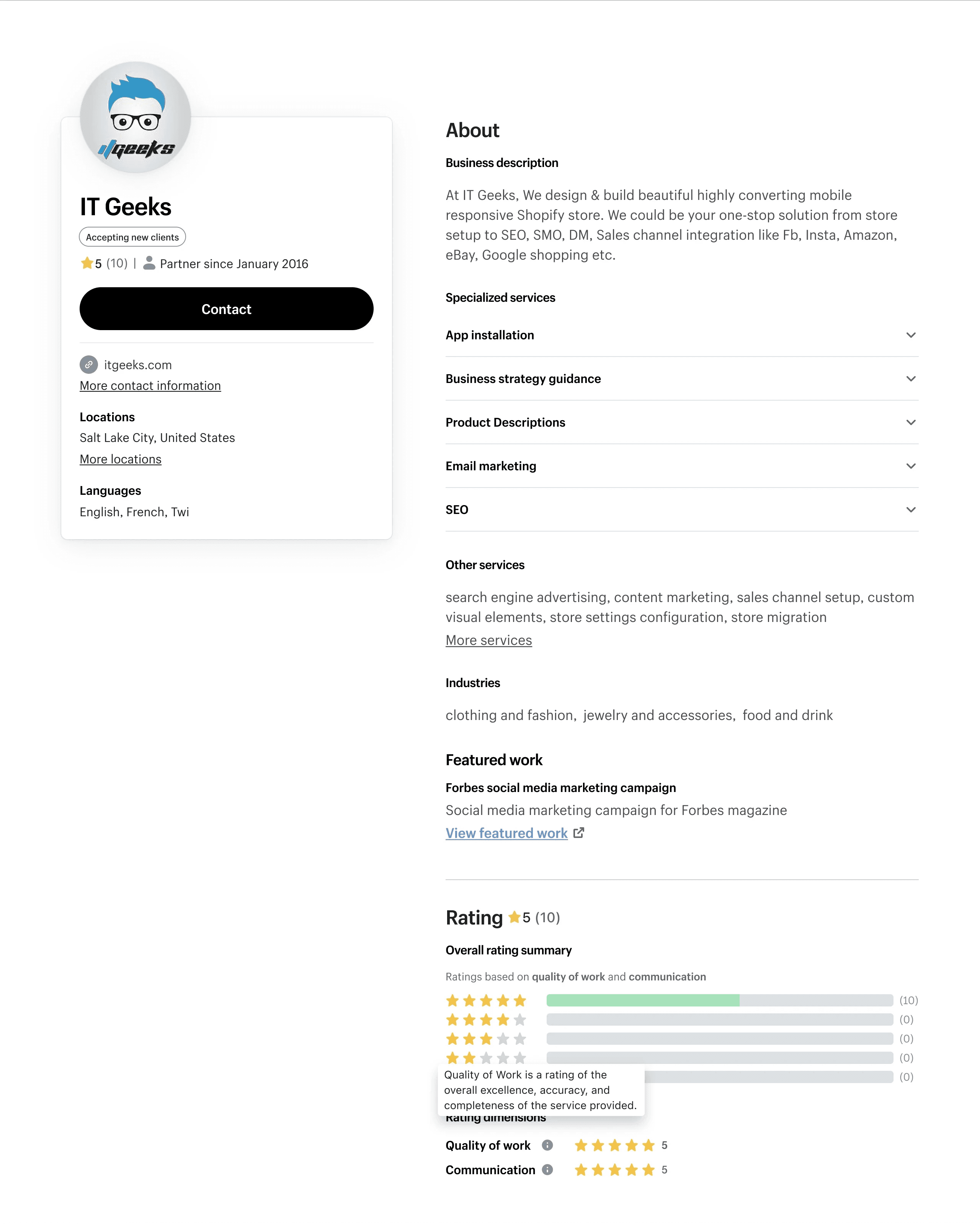
Partner profiles were redesigned around trust and evaluation. Structured information about services, expertise, certifications, reviews, and proof of work made providers easier to compare and assess.
Direct Partner Connections

Rather than maintaining complex marketplace messaging workflows, merchants could contact providers through a structured inquiry flow that captured project details and routed them directly to Partners.
04 — Impact & Reflection
Results
325,000+
Lines of code removed
Impact
Unified fragmented discovery experiences
Consolidated three separate Partner directories into a single marketplace experience, creating a consistent destination for discovery, evaluation, and connection.
Reduced technical debt
Retired legacy marketplace infrastructure and eliminated 325,000+ lines of code, reducing technical debt by 89%.
Simplified platform operations
Removing matching, messaging, and other marketplace workflows reduced maintenance complexity and operational overhead while creating a more scalable foundation for future Partner experiences.
Reflections
Designing for subtraction
The biggest impact came from removing features, not adding them. Eliminating legacy matching, messaging, and operational workflows simplified the experience while reducing platform complexity.
Trust emerges from systems, not features
I initially approached the project as a discovery challenge, but the deeper problem was helping merchants confidently evaluate providers. Trust wasn't created through badges alone—it emerged from consistent information architecture, transparent expertise signals, and meaningful proof of work.
Two-sided marketplaces require balanced incentives
Improving merchant discovery could not come at the expense of Partner experience. The final solution balanced accessibility for merchants with mechanisms that helped providers receive higher-quality leads and better matches.