Merchants moving to Shopify face a complex, months-long transition. This project explored personalized migration guidance powered by AI.
COMPANY
Shopify
ROLE
Lead Product Designer
Team
PM · Engineers · Content · Data
Timeline
5 Months

TL;DR
Designed end-to-end AI migration guidance for Shopify Sidekick. Led research with Launch Consultants, translated expert migration workflows into a 5-phase guidance system, and shipped an A/B experiment that drove a +16.5% directional lift in lead-to-customer conversion.
THE CHALLENGE
Replatformers (merchants moving their store to Shopify) faced a fundamentally different onboarding journey than new merchants, yet received the same onboarding experience. While Shopify offered migration support through Launch Consultants (Shopify specialists who help large merchants plan and execute migrations), many merchants didn't qualify for that level of assistance.
81%
Sought human expert support during migration evaluation
$5M+
Only merchants above $5 million annual sales received human launch support
15,500/week
Replatformer leads with no access to that support
2%
Of replatformers reached $1K revenue in their first six months
01 — VALIDATING THE OPPORTUNITY
Before building the system, we tested the appetite for it with an experiment.
Replatformers engaged with Sidekick more than any other merchant segment, suggesting unmet migration-support needs. Before investing in a larger solution, we ran an A/B/C experiment testing three versions of the screen-share entry point.
To validate demand, I designed the experiment experience and partnered with a Content Designer to develop migration-specific messaging and guidance for replatformers.
Control
No migration support entry point
Variant A
Generic screen share messaging

Variant B
Migration-specific messaging

Results
+18%
Median call duration
+16.5%
Lead-to-customer conversion (directional)
The increase wasn’t driven by messaging alone. We also improved the migration guidance merchants received during screen-share conversations.

Tailored migration guidance
I partnered with a Content Designer to update Sidekick’s migration resolution paths based on merchant session reviews, Gemini testing, and common migration questions surfaced through screen-share conversations. The fix wasn’t adding more information—it was helping merchants identify the right migration path and recommended tools for their situation.
New Capabilities:
Identified migration type (theme vs. data)
Recommended migration approaches
Suggested migration tools and services
Guided merchants to the right path based on complexity
02 — DESIGNING THE SYSTEM
We translated migration expertise into a structured guidance system.
To understand how migration experts guided merchants, I organized interviews and feedback sessions with Launch Consultants, reviewed screen-share recordings with our PM, and partnered with a Content Designer to test and refine migration guidance.
Through this research, we found that successful migrations followed a repeatable workflow: merchants needed help understanding their migration type, choosing the right approach, and making progress over time.
Our challenge wasn't generating answers—it was turning expert migration workflows into a scalable experience.
Research revealed a repeatable migration pattern. We built the system around it.
These insights revealed a repeatable migration pattern. Rather than presenting the full migration as a flat checklist, we grouped work into five phases and 14 core tasks. The phases provided structure and helped merchants understand the overall journey, while the guide remained flexible enough for merchants to complete work in the order that matched their business needs.

1
2
Store Configuration
3
4
Apps & Integrations
5
Launch Preparation
From phased planning to flexible execution
Research showed that successful migrations followed predictable phases, but merchants rarely completed work in a strictly linear sequence. We used phases to structure the plan while allowing progress to be tracked across tasks regardless of completion order.
03 — KEY DESIGN DECISIONS
Design Explorations
Decision 1 — Leverage Existing Guide vs. Build a New Experience
Explorations
A. Leverage Existing Guide — Selected

B. Build a New Experience

We explored whether migration guidance should live within Shopify's existing onboarding system or become a dedicated migration experience
We chose to extend Shopify's existing Guide architecture rather than build a new experience from scratch. This allowed us to ship quickly, learn directly from merchant behavior, and validate the value of personalized migration guidance before investing in entirely new infrastructure. Leveraging existing onboarding patterns also reduced engineering complexity and preserved familiar workflows for merchants.
Decision 2 — Multiple Guides vs. One Unified Guide
Explorations
A. One Unified Guide — Selected

B. Multiple Mini Guides

Early explorations divided migration support into phase-specific guides for migration, configuration, design, and launch. While highly contextual, the approach introduced multiple entry points and increased complexity.
We consolidated guidance into a single launch plan so merchants could access all migration activities from one place while preserving phase-based organization.
Decision 3 — Static Plan vs. Persistent Guide
Explorations
A. Persistent Guide — Selected

B. Static PDF Plan

Early concepts generated a complete launch plan up front. While the PDF provided structure, it couldn't adapt as merchants uncovered new questions and requirements throughout migration.
Launch Consultants continuously adjust guidance as merchants progress. To mirror that behavior, we combined conversational support with a persistent guide that evolved alongside the migration.
04 — DESIGNED SOLUTION
Turning Migration Expertise into Guided Workflows


The solution below reflects the experience we designed and validated through research and prototyping. The guidance and messaging updates from the experiment in Section 01 shipped to production and drove the results reported there.
Rationale
The final experience combined AI-powered intake, personalized launch planning, and contextual task guidance within Shopify's existing onboarding infrastructure. Rather than replacing the onboarding experience, we extended it with migration-specific support informed by Launch Consultant workflows.
1
Personalized intake
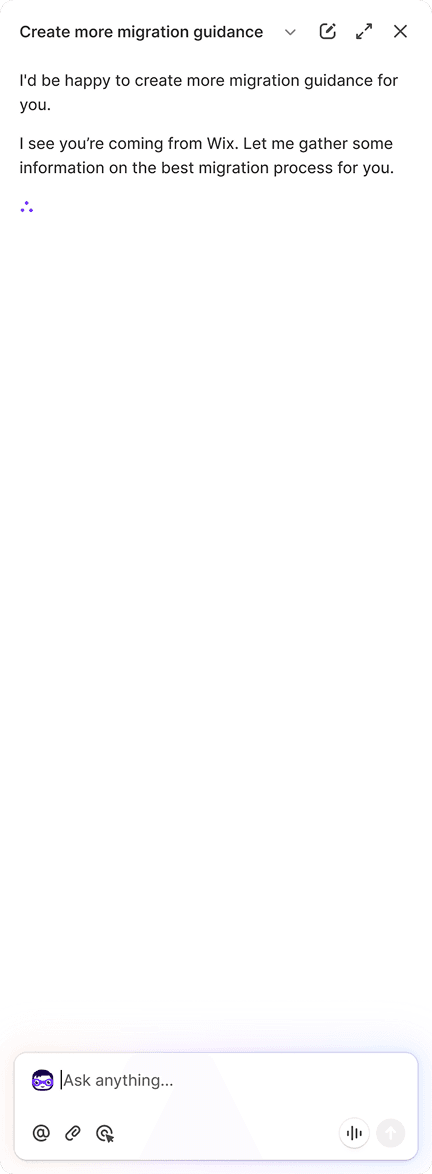
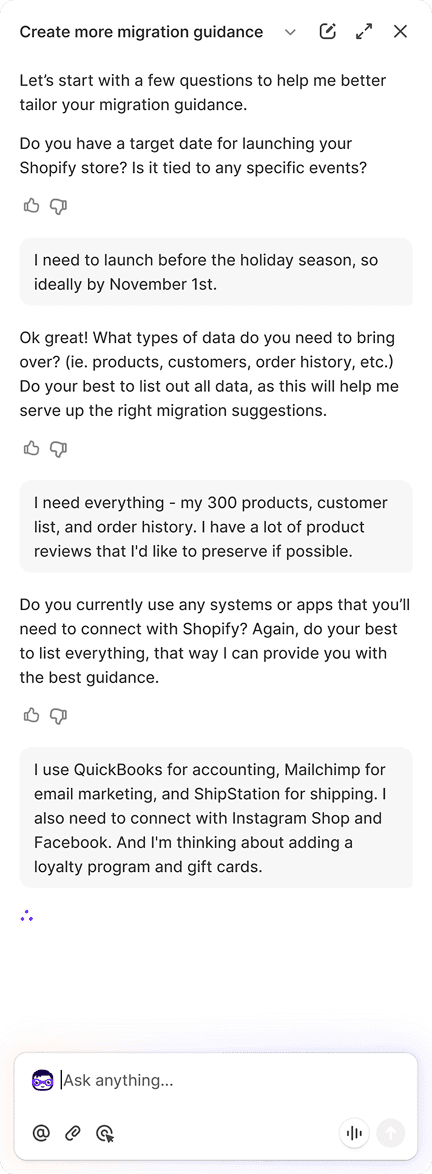

Launch Consultants began by understanding the merchant’s migration goals, timeline, data complexity, and existing tools before recommending a path forward. We translated that discovery process into a conversational intake that generated a personalized migration plan tailored to each merchant’s situation.
2
Guided task execution

Migration support didn’t end after planning. As merchants worked through their launch plan, Sidekick provided contextual guidance, recommended migration tools, and surfaced next steps directly within the workflow. This allowed merchants to get help without leaving the task they were trying to complete.
Support non-linear + track progress
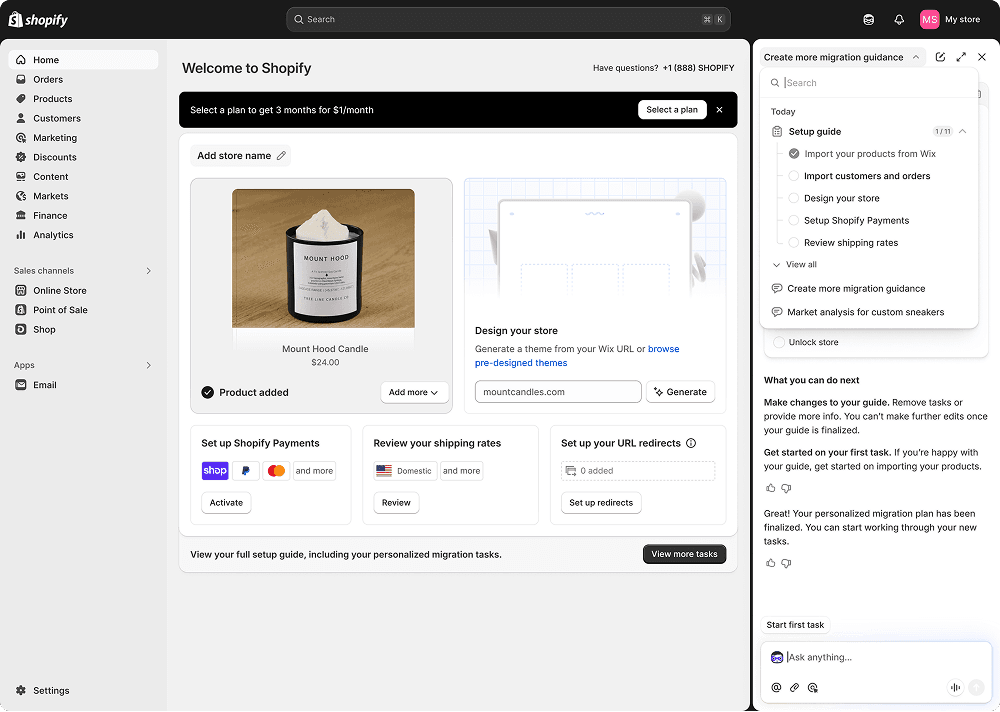
Real migrations rarely follow a linear sequence. Merchants often moved between setup, migration, and testing activities as priorities changed. The persistent guide tracked progress across tasks and phases while allowing merchants to work in the order that made sense for their business.
04 — Impact & Reflection
Impact
Established a framework for AI-powered migration guidance
Research with Launch Consultants, screen-share session reviews, and prompt testing revealed repeatable migration patterns that could be translated into scalable guidance. These findings became the foundation for a structured launch-planning system tailored to replatforming merchants.
Informed future AI guidance initiatives
What shipped: the guidance and messaging updates from our experiment, which drove the +16.5% conversion lift.
What was designed but not built: the full persistent-guide and task-execution experience. Validated through research and prototyping, it informed broader AI guidance initiatives at Shopify.
Cross-functional leadership
To develop the solution, I:
Organized interviews and feedback sessions with Launch Consultants
Synthesized findings from screen-share recordings and merchant conversations
Designed and iterated on migration guidance experiences
Partnered closely with Content Design, Product Management, and Data Science
Navigated evolving timelines, shifting priorities, and multiple parallel workstreams while maintaining alignment on the long-term vision
Reflections
Validate the riskiest assumption first
Before investing in a larger AI experience, we tested whether migration-specific support could change engagement and conversion.
AI wasn’t the solution; the workflow was
The breakthrough came from understanding how Launch Consultants structured migrations. AI became the delivery mechanism, but the real design challenge was translating expert workflows into a system merchants could follow independently.
Designing for flexibility over linearity
Merchants rarely completed migrations in a fixed sequence. Designing for flexibility allowed guidance to adapt to changing priorities while still providing a clear path to launch.